
Updated October 4, 2026
Satyagraha in History: From South Africa to India
The complete timeline of satyagraha — from Gandhi's first campaigns in South Africa in 1906 through Champaran, the Salt March and Quit India, to the 2026 digital platform.
Satyagraha is one of the most consequential political ideas of the twentieth century. Coined by Mohandas K. Gandhi in 1906 in South Africa, the method of nonviolent resistance based on holding firmly to truth drove India's independence movement, inspired civil rights campaigns across the globe, and in 2026 found a new digital expression. This page traces that full arc — from the first pledge at Johannesburg's Empire Theatre to the present day.
What does "satyagraha" mean?
The word combines the Sanskrit satya (truth) and agraha (firm holding) — literally "holding firmly to truth", often rendered as "truth-force". Gandhi coined it in 1906 through a competition in his newspaper Indian Opinion: reader Maganlal Gandhi suggested "Sadagraha", which Gandhi modified into "Satyagraha". The term was formally adopted around 1908, according to the Gandhi Heritage Portal. The concept draws on the principle of ahimsa, or nonviolence — read our full definition of satyagraha for how it differs from related ideas such as passive resistance and civil disobedience.
Where did satyagraha begin?
Satyagraha was born in South Africa, not India. Gandhi arrived there in 1893 as a young lawyer and spent 21 years confronting the racial laws of the Transvaal and Natal. The turning point came on 11 September 1906, when a mass meeting at the Empire Theatre in Johannesburg pledged resistance to the Transvaal Asiatic Registration Act — the so-called "Black Act", which required Indian residents to register and carry certificates. What followed — eight years of campaigns involving certificate burnings, voluntary imprisonment, and a 1913 march of striking miners — was the laboratory in which satyagraha was developed and tested. Read the full story of satyagraha in South Africa (1906–1914).
What were the major satyagrahas in India?
Gandhi returned to India in January 1915. Within three years he applied the method to three local struggles in western India, each of which became a testing ground for mass mobilisation.
Champaran (1917)
Gandhi's first satyagraha in India, taken up at the invitation of peasant representative Raj Kumar Shukla. In Champaran, Bihar, the tinkathia system forced tenant farmers to grow indigo on 3/20 of their land for British planters. Gandhi defied a Section 144 order at Motihari in April 1917, submitted a preliminary report on 13 May 1917, and the resulting Champaran Agrarian Act of 1918 abolished tinkathia. Read the full Champaran account.
Kheda (1918)
In Kheda district, Gujarat, monsoon failure and a plague epidemic that killed over 17,000 people devastated the 1917–18 harvest. Although the Bombay Revenue Code entitled peasants to full remission when yields fell below 25% of normal, officials demanded full revenue. Gandhi and Vallabhbhai Patel organised a no-tax campaign; the government relented in June 1918, collecting revenue only from those who could pay. Read the full Kheda account.
Ahmedabad mill strike (1918)
An industrial dispute over the withdrawal of a plague bonus: textile workers demanded a 35% wage hike. Gandhi mediated, undertook his first hunger strike in India when the talks stalled, and the strike ended successfully — proving satyagraha worked in urban labour disputes as well as peasant revolts.
How did satyagraha become a national movement?
The local campaigns of 1917–18 were a rehearsal. From 1919 onward, satyagraha became an all-India method.
- Rowlatt satyagraha (1919): a nationwide hartal against the Rowlatt Act, which permitted detention without trial. The agitation was followed by the Jallianwala Bagh massacre of 13 April 1919.
- Non-cooperation (1920–22): the first mass non-cooperation movement, drawing millions into boycotts of British institutions. Gandhi suspended it after the Chauri Chaura violence in February 1922.
- Bardoli (1928): led by Vallabhbhai Patel against a steep land-revenue hike in Bardoli taluk, Gujarat; its success earned Patel the title "Sardar".
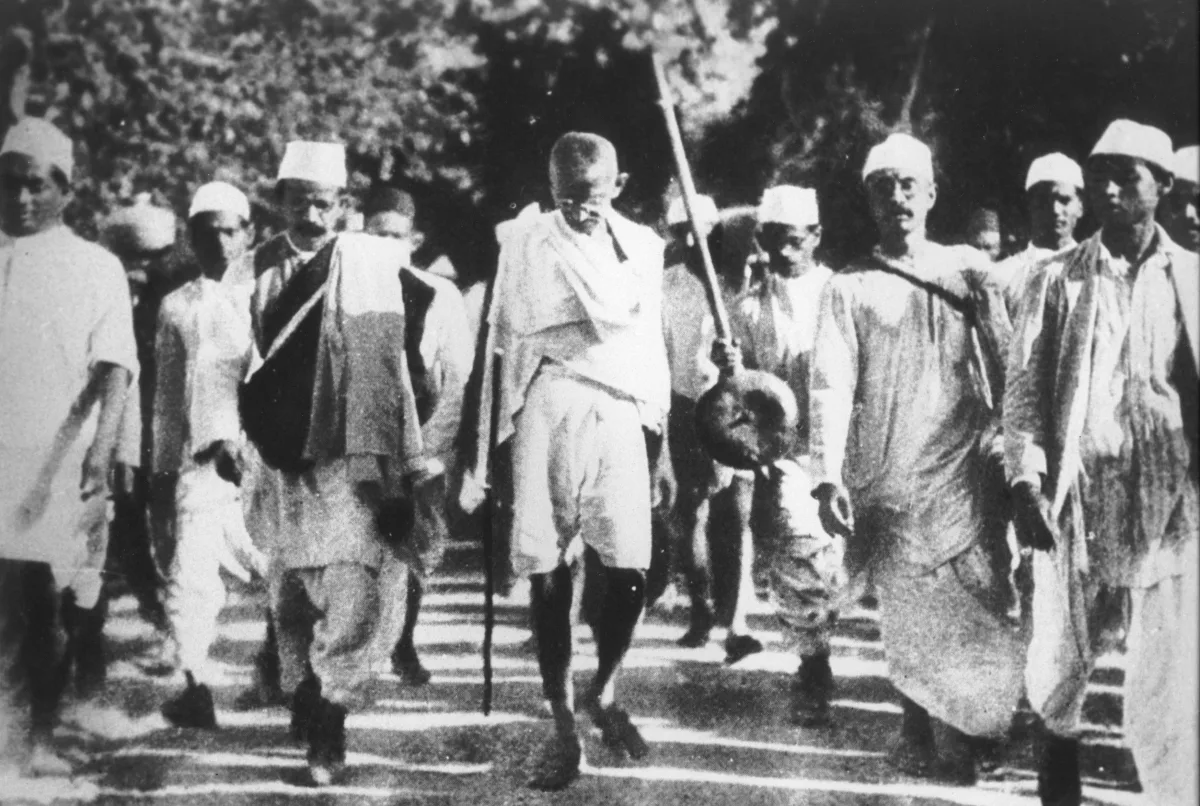
- Salt March (1930): from 12 March to 6 April 1930, Gandhi led 78 volunteers on the ~387 km march from Sabarmati Ashram to Dandi, breaking the salt law on 6 April. The Dharasana satyagraha of 21 May, led by Sarojini Naidu and covered by American journalist Webb Miller, showed the world satyagraha's discipline; over 60,000 Indians were jailed. Read the full Salt March account.
- Quit India (1942): launched with Gandhi's "Do or Die" call, the final mass uprising of the independence movement.
What happened after independence?
India's independence in 1947 did not end satyagraha's relevance. The method travelled: Martin Luther King Jr. and the American civil rights movement drew on it, as did later movements from anti-apartheid resistance in South Africa to peaceful pro-democracy campaigns. Within India, satyagrahas continued to be organised on issues from land reform to environmental protection. Read about satyagraha in modern movements. For the method's practical code, see the methods of satyagraha and its guidelines for participants.
What is the 2026 "Satyagraha" platform?
On 3 October 2026, Rahul Gandhi, Leader of the Opposition in the Lok Sabha, launched a digital platform named "Satyagraha" — a new, online chapter in the word's 120-year history. It presents itself as a platform for public engagement rooted in Gandhi's philosophy. This site is independent and unaffiliated with that platform, its organisers, or any political party; read our factual overview of the 2026 platform.
From the Empire Theatre in 1906 to a smartphone app in 2026, the core idea has stayed constant: that disciplined, truthful nonviolence can confront unjust power. The campaigns above are where that idea was forged — and they remain worth studying on their own terms. Start at the beginning with satyagraha in South Africa, or return to the homepage for the full site index. Sources and references are collected on the sources page, including the Gandhi Heritage Portal, Wikipedia's satyagraha article, and mkgandhi.org.